Electro-Spark Deposition: Overview and Mechanism
SparkDepo is TechnoCoat's electro-spark deposition (ESD) process for coating and on-site overlay repair of machine components, molds and dies.
Coating for machine components, molds and dies life-up
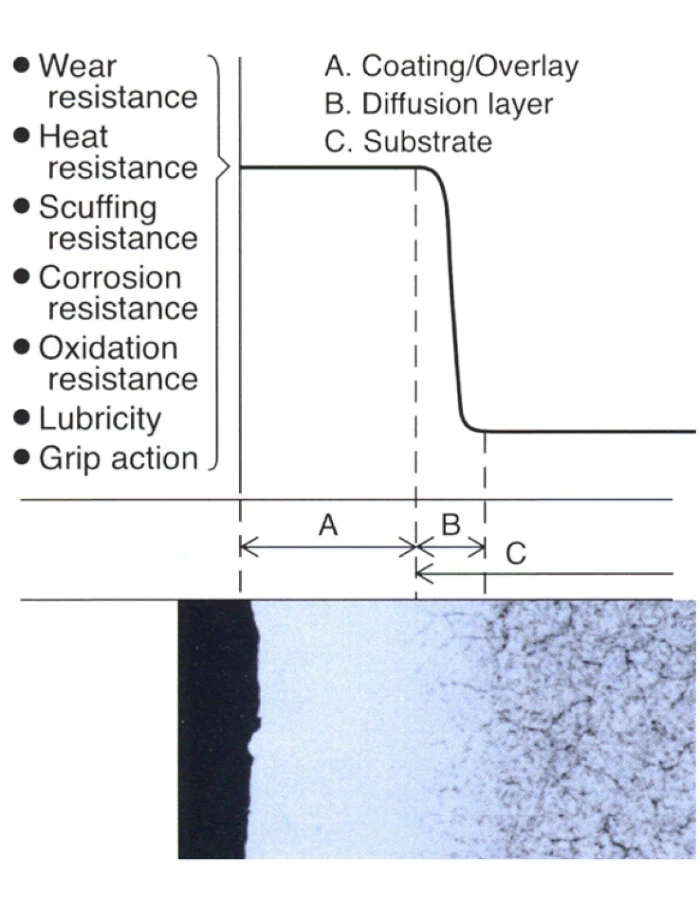
The coating with WC, TiC, Cr3C2, etc. protects the surface due to its extreme wear resistance, heat resistance, scuffing resistance, and corrosion resistance.
Easy on-site overlay repair by anyone
Overlay repair for scratching, scuffing, wearing, corrosion and pinholes using Ni, Co, Cu, and Al alloys, with low heat input that avoids the distortion and cracking risks of conventional welding.
Reduced downtime
Reduces downtime for repair and the number of spare parts kept in inventory, since worn dies and molds can be repaired on-site instead of replaced.
How electro-spark deposition works
Electro-spark deposition (ESD) is a low-heat-input electrical discharge process. A rotating or vibrating electrode is brought into repeated contact with the workpiece; each spark discharge transfers a microscopic amount of the electrode material and metallurgically bonds it to the substrate surface. Because the heat-affected zone is extremely small and localized, ESD coating and overlay can be applied without the distortion, residual stress, or cracking risk associated with conventional welding or thermal spray processes.
The process is controlled through three main parameters — output capacitance, output voltage, and spark frequency — which together determine deposition speed, surface roughness, and diffusion depth. TechnoCoat's SparkDepo power units (Model 200 and Model 300) and the MicroDepo Model 150 implement this process at different power/output levels for industrial and portable use.
| Device | Input | Output capacity | Frequency range | Dimensions | Weight |
|---|---|---|---|---|---|
| MicroDepo Model 150 | 100V AC single phase (110/200/220V available) | 500 VA max. | 60–1,600 Hz | 255W×320D×290H mm | 14.7 kg |
| SparkDepo Model 200 | 220V AC single phase, 50/60 Hz | 1.6 kVA | 60–2,000 Hz | 323W×420D×410H mm | 31.4 kg |
| SparkDepo Model 300 | 220V AC single phase, 50/60 Hz | 2.0 kVA | 60–2,000 Hz | 323W×420D×410H mm | 31.8 kg |
Principle diagram
Frequently asked questions